

For families in the United States exploring international schools in Thailand, searching for a kindergarten trial program Phuket can be the start of a bigger question: how will your child experience everyday school life? Spending time in a classroom can show you how learning unfolds, how relationships begin, and whether your child feels comfortable joining in.
It’s natural to wonder whether your child will settle in and whether the classroom culture and curriculum will suit them. A website or brief visit can introduce a school, but taking part in its daily rhythm can reveal details that are hard to assess from a first impression alone.
At Oak Meadow International School Phuket, the Short Term Trial Programme lasts two weeks or more. Trial students join regular classes at their grade level and participate in academic and extracurricular activities. In this article, you’ll learn what the trial involves and what to observe in your child’s learning, connections with others, and comfort at school. These firsthand insights can help your family consider Oak Meadow’s American-curriculum pathway and decide on a thoughtful next step.
Key Takeaways
- A school trial lets United States-based families experience an international-school environment firsthand, beyond a website or tour.
- Notice your child’s engagement, relationships, comfort, and participation without expecting them to feel confident straight away.
- Plan for the application process: submit the application at least one week ahead and wait for acceptance before beginning the trial.
- After the trial, distinguish what you observed from assumptions about how your child might adjust over time.
What a Kindergarten Trial Program in Phuket Lets Your Family Experience
For families in the United States considering a move or an international-school option in Thailand, a kindergarten trial program phuket offers a firsthand view of everyday learning before a longer-term decision. Rather than relying only on a campus tour, you can see how your child experiences regular school life. Oak Meadow International School Phuket’s Short Term Trial Programme lasts two weeks or longer. Students join classes at their grade level and take part in school activities, giving families useful context without promising the same experience for every child.
Kindergarten brings together early learning, relationships, and growing independence. For a broader overview of the field, see this introduction to early childhood education. A trial lets your family consider these dimensions through your child’s own experience at Oak Meadow.
What happens during Oak Meadow's Short Term Trial Programme?
Trial students join regular classes corresponding to their grade level and participate in academic and extracurricular activities. They experience the school’s regular learning environment, rather than a separate demonstration for visitors. A tour introduces the campus, but it offers only a snapshot. By joining classes over the trial period, your child can experience more of the daily routine, while you observe how they engage with it.
Why consider a kindergarten trial in Phuket?
For a family based in the United States, choosing a school in another country can raise questions that curriculum descriptions alone can’t answer. Everyday interactions may show how your child approaches activities, responds to the setting, and begins connecting with a new community. Starting at an unfamiliar school takes adjustment, so look for patterns rather than expecting immediate confidence.
Families considering Oak Meadow’s American-curriculum pathway can use the trial as one point of reference when weighing a longer-term direction. Notice specific moments: your child showing curiosity, accepting support, or beginning to engage with classmates. These observations can help your family reflect on the experience without treating it as a test or a promise of a particular outcome.
What a Phuket Kindergarten Trial Can Reveal About Learning and Belonging
A trial helps you look beyond whether your child seems happy on the first day. Notice patterns across learning, relationships, comfort, and participation, keeping in mind that a new setting can take time to feel familiar. A trial provides firsthand context for a school decision, not a guaranteed prediction of how a child will adjust over time.
Notice curiosity, participation, and classroom learning
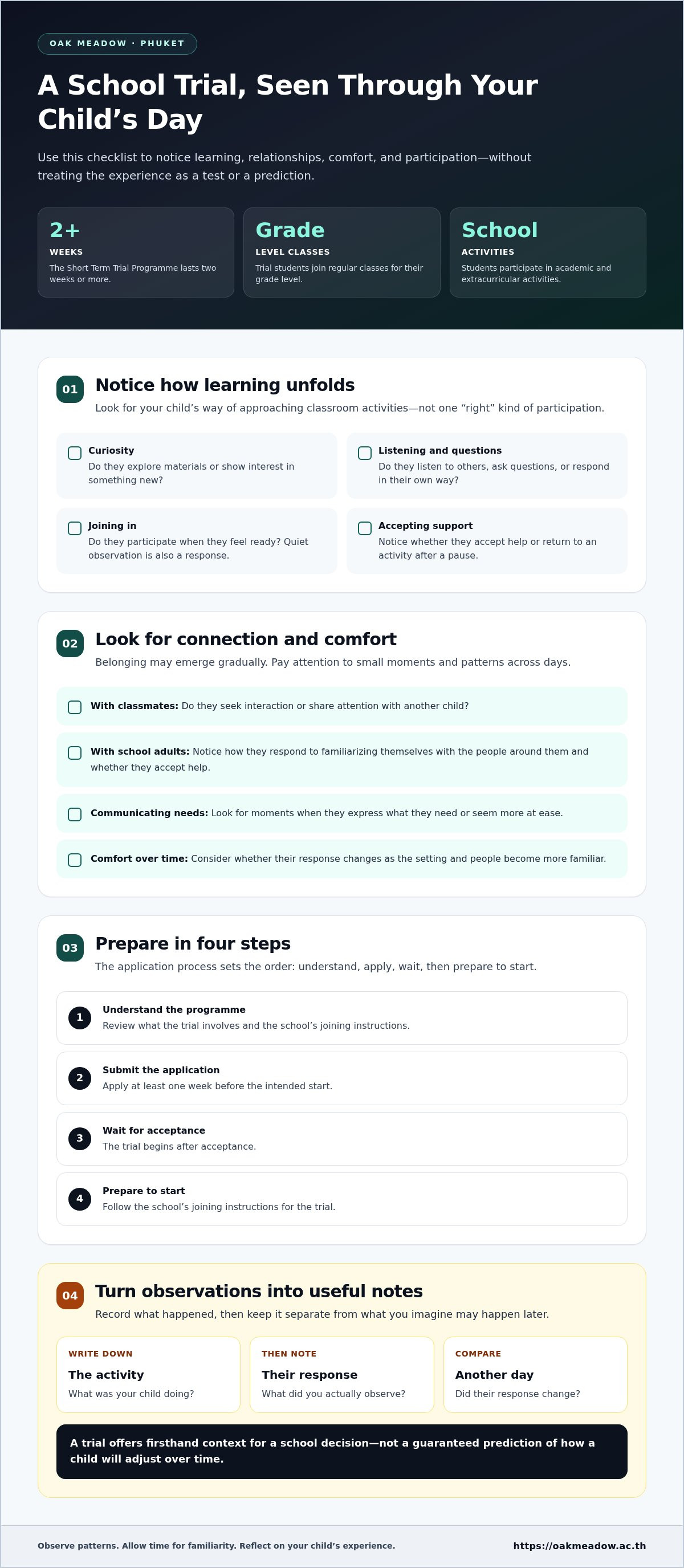
During classroom activities, consider how your child approaches something new. Do they explore materials, listen to others, ask questions, or join in when they feel ready? Participation can be quiet or gradual. A child who watches before taking part is still showing you how they process the experience. Oak Meadow’s American-curriculum context is one part of the picture; your observations can also help you consider how your child responds to the learning environment itself.
The American Academy of Pediatrics’ discussion of School readiness considers development across cognitive, social, and emotional dimensions. Use that broad perspective to reflect on your child’s experience, not to score their readiness or compare them with other children.
Look for relationships, comfort, and a sense of belonging
Notice how your child responds to classmates and school adults. Do they seek interaction, accept help, or seem more at ease as they become familiar with the people around them? There’s no single sign that proves a child belongs, and comfort may develop gradually.
Wellbeing and participation can show up in small moments: returning to an activity after a pause, sharing attention with another child, or communicating a need. Consider these observations alongside your own sense of whether the environment feels welcoming and supportive for your family. For more context about Oak Meadow’s educational approach, explore the Oak Meadow International School Phuket website.
If you’re considering a kindergarten trial program phuket option, keep brief notes on what you actually observe and how your child describes the experience. For instance, record the activity, how your child responded, and whether their response changed on another day. Separating those details from assumptions about what they’ll feel after a longer time at school can support a more thoughtful conversation about fit.
How to Prepare for a Kindergarten Trial Program in Phuket
A little preparation can make the experience clearer for both you and your child. Oak Meadow’s application process is straightforward: understand the programme, submit an application at least one week before the intended start, and wait for acceptance before beginning the trial.
- Understand the programme: Review what the trial involves and the school’s joining instructions.
- Submit the application: Apply at least one week before the intended start.
- Wait for a response: The trial begins after acceptance.
- Prepare to start: Follow the school’s joining instructions for the trial.
For families comparing school options in Thailand, the Centre for Asian Philanthropy and Society’s overview of Early Childhood Education in Thailand offers broader context on the country’s early-years landscape. It can help frame your research, while the trial lets you focus on your child’s own experience at Oak Meadow.
Prepare your child for the first days
Use calm, simple language to explain that they’ll spend time in a class, meet people, and try school activities. Avoid promising that every moment will feel easy. Instead, invite questions and allow for mixed feelings: “What are you curious about?” or “Is anything making you feel unsure?” Following the school’s application and joining instructions also helps you prepare your child for the start of the trial.
Make useful observations during the trial
Keep brief notes on participation, comfort, and interactions, then compare what you notice across different days. One quiet morning or enthusiastic activity won’t tell the whole story. Use your family’s priorities to guide your reflection. For example, consider whether your child seems able to engage with activities and seek support, rather than treating their responses as a checklist of guaranteed outcomes.
For parents researching “kindergarten trial program phuket,” a considered process can turn uncertainty into useful questions and observations. Explore Oak Meadow International School and its trial programme information as you prepare your next step.
After the Phuket Kindergarten Trial: Turn Firsthand Experience Into Next Steps
A trial gives your family lived experience to reflect on, but it can’t predict exactly how your child will feel after a longer period at school. Review what you observed across learning, relationships, comfort, and participation, then consider how those experiences connect with your family’s priorities. This turns impressions into thoughtful questions instead of a rushed yes-or-no decision.
Reflect on what you and your child experienced
Start with open questions that let your child describe the experience in their own words: “What did you enjoy?” “What did you notice?” or “Was anything new or unfamiliar?” Avoid suggesting the answer you hope to hear. Their comments may be brief, so consider them alongside your own observations from more than one day.
Separate what happened from what you imagine it might mean. For example, a child watching an activity before joining is an observation; assuming they’ll always be hesitant is a prediction. Then consider whether the learning environment and school community seem aligned with what your family values, such as supportive relationships, meaningful participation, and comfort.
Choose a clear next step with Oak Meadow
Oak Meadow offers an American-curriculum pathway from kindergarten through high school, giving families a longer-term educational context to consider alongside the trial experience. If you’re still gathering information, a school tour or a conversation about your family’s interests can help you explore the environment further. If the trial has given you useful clarity, the programme information and application route can guide your next step.
There’s no need to treat one response as the whole story. Bring together your child’s reflections, your observations, and the questions that remain. When you’re ready, Explore Oak Meadow's trial programme for details and a considered way forward. A kindergarten trial program phuket families choose can be one meaningful part of deciding whether a school feels right for their child and their longer-term journey.
Use the Trial Experience to Choose Your Next Step
A thoughtful school decision grows from more than a first impression. During a kindergarten trial program phuket experience, notice how your child engages with learning, relates to others, and becomes comfortable participating. Then reflect on what you observed across the trial, keeping those moments distinct from assumptions about how your child may adjust over time.
At Oak Meadow, trial students join regular classes at their grade level and take part in academic and extracurricular activities. This firsthand experience can help your family consider the school environment alongside Oak Meadow’s American-curriculum pathway from kindergarten through high school.
If you’re ready to learn more, Explore Oak Meadow's Short Term Trial Programme and take the next step for your family. Each child settles into a new community in their own way. A considered decision can begin with curiosity, careful observation, and an open conversation.
Frequently Asked Questions
How long is Oak Meadow's Short Term Trial Programme?
Oak Meadow’s Short Term Trial Programme lasts two weeks or longer. This gives your child an immersive experience of regular school life rather than a brief introductory visit. During the trial, students join classes at their grade level and participate in academic and extracurricular activities. You can observe how your child responds to the learning environment while remembering that each child’s adjustment is individual.
Can my child join regular kindergarten classes during the trial?
Yes. Trial students join regular classes corresponding to their grade level, so a kindergarten applicant participates with the appropriate grade-level class. The programme also includes academic and extracurricular activities, offering a broader experience of school life than a campus tour alone. Use the time to notice how your child approaches activities, interacts with others, and becomes comfortable participating, without expecting a particular response or outcome.
How far in advance should families apply for the trial programme?
Submit the application at least one week in advance. Plan around your intended trial period and complete the application before making arrangements based on a start date. Once you’ve submitted it, wait for Oak Meadow’s response and follow the joining instructions provided after acceptance.
What happens after Oak Meadow receives a trial application?
After receiving an application, Oak Meadow reviews it for the grade level applied for. The trial begins after acceptance and according to the school’s joining instructions. The application information describes possible interviews for elementary, middle, and high school applicants. Follow the instructions provided for your child’s grade and wait for the school’s response before planning the start.
What should parents look for during a kindergarten school trial?
Observe your child’s learning, relationships, comfort, and participation throughout the experience. For example, notice whether they explore an activity, listen, ask questions, join in at their own pace, or seek support from classmates and school adults. Compare observations across different days where possible, and ask your child open questions about what felt enjoyable or unfamiliar. A kindergarten trial program phuket families consider can provide firsthand context, not a pass-or-fail assessment.
Does a school trial guarantee that a child will settle in quickly?
No. A trial offers a chance to experience school life, but it can’t guarantee how quickly a child will settle into a new community over time. Children may need different amounts of time to feel comfortable, and their responses during the trial are observations, not predictions. Consider what your child experiences alongside your family’s priorities, then use any remaining questions to guide a thoughtful decision about a longer-term school path.

