

If you’re searching for an American high school diploma in Phuket, start by separating the curriculum a student follows from the credential they earn. Studying an American curriculum does not, by itself, identify the graduation credential.
Families often compare a school-based high school experience with the GED, particularly when future university plans are involved. These are different pathways: one involves learning through a school program, while the other is an equivalency test. Understanding how each route works can help you compare learning format, support, assessment, and future requirements.
Use this guide to connect a student’s learning preferences and goals with the questions to consider about further study. Oak Meadow International School Phuket offers a high school program as part of a wider school community and learning journey. Its Short Term Trial Programme gives families an opportunity to experience the learning environment as they consider their next steps.
Key Takeaways
- An American curriculum describes a learning framework; it does not, by itself, identify the graduation credential a student earns.
- Compare school-based study and the GED by learning format, support, assessment, and the structure that suits the student.
- Consider the student’s intended further study and learning needs when weighing credential pathways.
- Review the requirements of future institutions before choosing, since admissions and credential recognition can differ.
- Explore Oak Meadow’s high school learning environment as part of a structured school journey, including through its Short Term Trial Programme.
What Does an American High School Diploma in Phuket Mean?
An American curriculum describes an educational framework; it does not automatically identify the diploma a student will earn. When comparing an American high school pathway with the GED, separate three questions: what the student studies, how they complete high school, and which credential is awarded.
American curriculum, high school completion, and diploma: what is the difference?
A curriculum sets out the subjects, learning goals, and approaches that shape a student’s education. High school completion means meeting the requirements of a particular program, while a diploma is the credential awarded after those requirements are fulfilled. In the United States, an American high school diploma generally represents completion of secondary school, though specific requirements can vary.
The curriculum label alone does not establish the graduation credential or how another institution will recognize it. The awarding body, program completion criteria, and the institution assessing the credential all matter. Consider these details alongside the learning framework when planning a student’s next step.
How does the GED differ from a school-based pathway?
The GED is an exam-based high school equivalency credential, not a curriculum or a school diploma. A student may prepare independently or through a preparation course, focusing on the knowledge and skills assessed by the exams. This route centres on readiness for those assessments rather than participation in an ongoing high school program.
School-based study, by contrast, involves classes over time, teacher guidance, ongoing learning, and a school community. Students work through a program’s learning and completion requirements rather than relying on an equivalency exam alone. These routes are not interchangeable. The better fit depends on the student’s learning preferences and plans.
In the United States, families may encounter American curriculum as a framework of study, high school diploma as a school-completion credential, and GED as an exam-based equivalency credential. Receiving schools, universities, and other institutions set their own admissions and credential requirements. Keep the student’s intended next step in view when comparing pathways.
GED or American-Curriculum High School in Phuket: How the Routes Differ
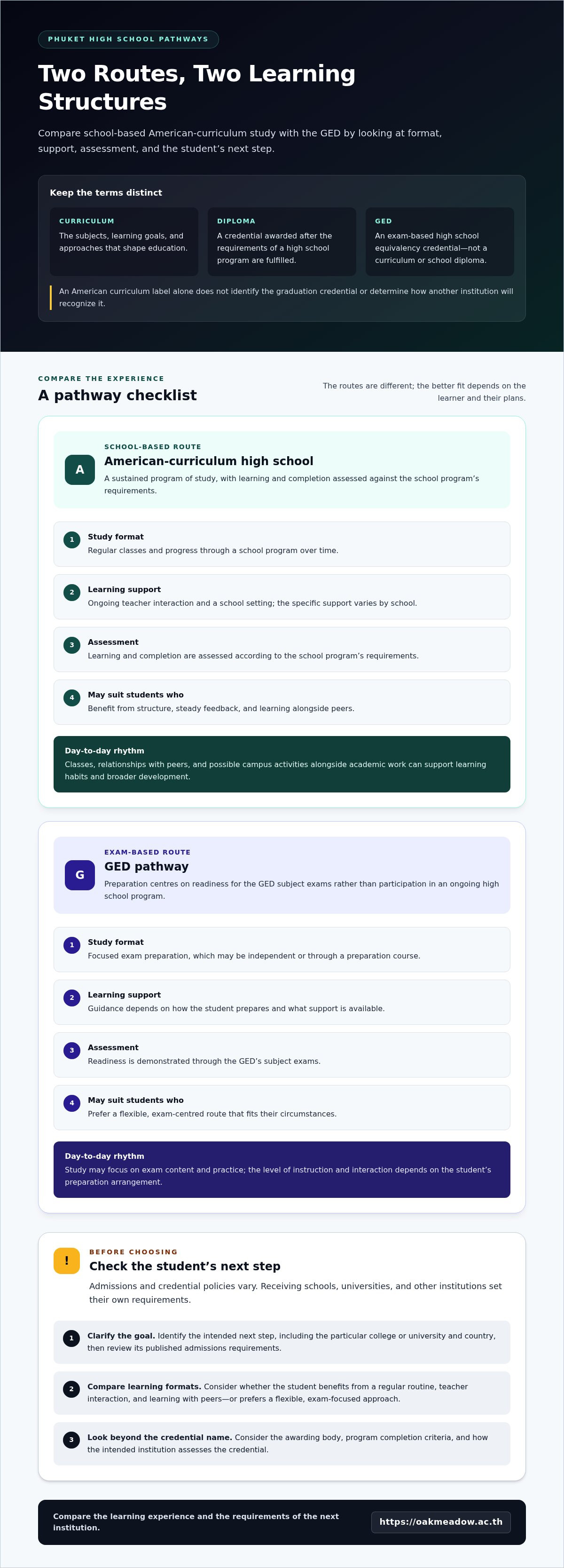
Both routes may support a student’s next steps, but they offer different learning experiences. School-based high school is a sustained program of study, while GED preparation centres on readiness for an equivalency exam. The right choice depends on the student and their circumstances.
| Area | American-curriculum high school | GED pathway |
|---|---|---|
| Study format | Regular classes and progress through a school program over time. | Focused preparation for exams, which may be independent or supported by a preparation course. |
| Learning support | Ongoing teacher interaction and a school setting; the specific support varies by school. | Study guidance depends on how the student prepares and the support available to them. |
| Assessment | Learning and completion are assessed according to the school program’s requirements. | Readiness is demonstrated through the GED’s subject exams. |
| May suit students who | Benefit from structure, steady feedback, and learning alongside peers. | Prefer a flexible, exam-centred route that fits their circumstances. |
What is the day-to-day learning experience in each pathway?
In a school program, students take part in classes, build relationships with peers, and may join campus activities alongside academic work. This regular rhythm can support learning habits and broader development. GED preparation may focus study time on exam content and practice; the level of instruction and interaction depends on the student’s preparation arrangement. The difference is not just where a student studies, but how learning is organized and supported.
Which route may suit a student's learning needs and goals?
Think about whether the student thrives with consistent routines, teacher feedback, and a school community, or would be better served by a more flexible, exam-focused approach. Then work backward from the intended next step. Admissions and credential policies vary, so review the published requirements of the specific institution the student hopes to attend.
U.S. completion requirements also depend on the education context. For example, this federal education regulation sets requirements for a particular school context, not a universal standard for every U.S. high school. Families weighing American high school diploma options in Phuket can explore Oak Meadow’s American-curriculum high school program as a structured, school-based learning environment.
How to Choose a High School Pathway in Phuket: Four Practical Steps
A considered choice starts with the student’s needs and ends with a clear understanding of what the next institution requires. Use these four steps to compare an American high school diploma pathway in Phuket with other options, without assuming one route is right for every learner.
- 1. Clarify the goal. Identify the student’s intended next step, such as applying to a particular college or university, before choosing a credential pathway. Note the institution and country, then review its published admissions requirements. This gives you a real goal against which to assess each option, rather than relying on a credential’s name alone.
- 2. Compare learning formats. Consider whether the student benefits from a regular school routine, ongoing teacher interaction, and learning with peers, or whether flexible, exam-focused preparation better fits their circumstances. Reflect on academic confidence, independence, social connection, and wellbeing together. A pathway should support the learner as a whole, not just prepare them for an assessment.
- 3. Check credential requirements. Review the exact qualifications, subjects, records, and other materials required by each intended receiving institution. Admissions and credential-recognition policies can differ, so use that institution’s published guidance rather than assuming a curriculum label or equivalency credential guarantees acceptance. If plans are still taking shape, compare the requirements of several possible destinations.
- 4. Experience the school. For a school-based option, look beyond the program description. Consider how its academic structure, support, assessment, and campus participation may fit the student’s learning needs. Oak Meadow International School Phuket offers a Short Term Trial Programme, giving families an opportunity to experience its school environment as they consider a high school pathway.
In short, Phuket families can clarify the student’s goal, compare learning formats, review the receiving institution’s credential requirements, and experience the school environment. These steps bring academic plans and day-to-day fit into the same decision, helping families make a considered choice without assuming a particular admissions outcome.
Explore Oak Meadow’s American-curriculum high school program as you consider a structured school learning environment in Phuket.
Explore Oak Meadow's American-Curriculum High School in Phuket
For families considering an American high school diploma pathway in Phuket, Oak Meadow International School Phuket offers American-curriculum education through high school. The high school program is part of a broader school journey, providing a structured setting for continued learning and development. When planning future study, consider the program’s completion requirements and the credential awarded alongside the curriculum approach.
What can families explore at Oak Meadow in Phuket?
Oak Meadow offers programs from kindergarten through high school, creating a continuous learning community across school stages. Dedicated academic tracks provide structure as students progress, and the high school program forms part of this wider educational journey. On-campus extra classes and activities give students opportunities to explore interests and take part in school life beyond their core studies.
This broader context can help families look beyond the final credential and consider how a student may learn, participate, and develop day to day. As you explore the program, reflect on the student’s academic goals, preferred learning environment, and the support that helps them feel ready to engage.
How can a trial help families understand school fit?
Reading about a school provides useful context, but experiencing its environment can make the decision more tangible. Oak Meadow’s Short Term Trial Programme gives families an opportunity to experience the school setting. During the trial, notice whether the student feels comfortable engaging with learning, shows curiosity, and begins to develop a sense of belonging. These observations can help clarify whether a structured school pathway feels like a good fit.
Bring questions about the learning approach, program structure, and the student’s next steps as you explore. Pair what you learn about the school with the intended receiving institution’s published credential requirements, so the learning experience and future plans remain aligned.
Explore Oak Meadow International School Phuket to learn more about its educational approach and programs, including the high school pathway.
Choose a Pathway That Supports the Student’s Next Chapter
The right American high school diploma pathway in Phuket depends on more than its label. An American curriculum describes how learning is organized, while a diploma and the GED represent distinct credentials with different routes to completion. Start with the student’s future study plans, then compare the relevant institutions’ published requirements with the learning format that best supports their confidence, independence, and wellbeing.
For families drawn to a structured school journey, Oak Meadow International School Phuket offers American-curriculum programs from kindergarten through high school. Its Short Term Trial Programme gives students and families an opportunity to experience the school environment, while extra classes and activities contribute to campus life.
Take the next step at your family’s pace. Explore Oak Meadow's American-curriculum programs in Phuket to learn more about the school’s educational approach. A considered choice can help your student move forward with purpose, curiosity, and confidence.
Frequently Asked Questions
Is an American curriculum the same as an American high school diploma?
No. An American curriculum describes the learning framework, including the subjects and approaches that shape a student’s education. A diploma is a completion credential awarded after a student meets a particular program’s requirements. The curriculum label alone does not establish who awards the credential or whether another institution will recognize it. Before choosing a pathway, review the program details and the published requirements of colleges or universities the student may apply to.
Can students earn an American high school diploma in Phuket?
Phuket families can consider school-based programs as well as exam-based equivalency routes, but studying an American curriculum does not automatically mean earning a particular American high school diploma. The credential depends on the program’s completion requirements and awarding body. Compare the documented details of a school pathway with the published admissions requirements of the institution the student hopes to attend. This helps align the learning experience and credential with future plans.
Is the GED the same as a US high school diploma?
No. The GED is an exam-based high school equivalency credential, while a school diploma is generally awarded after completing a school program’s requirements. They represent different routes and should not be assumed to be interchangeable. Whether either credential meets a particular requirement depends on the receiving institution or organization. Review its published admissions or credential policies before deciding, especially when the student has a specific college, university, or other next step in mind.
How do I choose between GED preparation and high school in Phuket?
Compare the student’s preferred structure, need for ongoing classes and support, exam readiness, and future study goals. A school environment may offer sustained learning, teacher interaction, and a peer community, while GED preparation focuses on exam readiness and may suit different circumstances. Neither route is universally best. Before choosing, review the published credential requirements of the institution the student hopes to attend.
What should I check before choosing a high school credential for university?
Start by identifying the intended university and reviewing its current admissions requirements. Look for details about graduation credentials, school records, required subjects, and any additional assessments. Recognition can differ by institution and program, so broad claims that a qualification is accepted everywhere may not reflect the requirements for a particular application. Use the university’s published guidance to compare pathways and plan the student’s next steps.
Can a student try a school before committing to a high school pathway?
Yes. Experiencing a school can help a student and family understand its teaching environment, routines, and community. Oak Meadow International School Phuket offers a Short Term Trial Programme, giving families an opportunity to experience the school environment and teaching methodology firsthand. Afterward, reflect on the student’s engagement, comfort, and sense of belonging alongside academic needs and future goals. These observations can help families consider whether a school-based pathway feels like a supportive fit.
