

What if the most important skills your child needs for the 2040 workforce aren't found in the back of a textbook? As a parent in 2026, you've likely felt that nagging worry that traditional education is moving too slowly for a rapidly changing world. You want your child to be more than a passive recipient of information; you want them to be a thinker, a creator, and a leader. It's natural to feel overwhelmed by educational buzzwords, especially when you're trying to balance the desire for innovation with the necessity of rigorous American academic standards.
We understand that finding a school that honors both your child's curiosity and their academic future is a deeply personal journey. This guide will help you discover how authentic project-based learning primary school phuket programs transform the classroom into a laboratory for life. We'll explore how this methodology fosters deep inquiry, builds emotional resilience, and ensures your child masters core subjects through meaningful, real-world application. We'll provide a clear framework to help you distinguish between true innovation and mere marketing, including a practical checklist for your next school tour. By the end, you'll understand how a nurturing, inquiry-based environment provides the stable foundation your child needs to flourish in an uncertain future.
Key Takeaways
- Understand how project-based learning primary school phuket programs move beyond passive memorization to cultivate active inquiry, critical thinking, and real-world leadership.
- Discover how rigorous American academic standards are integrated into project milestones, ensuring your child masters essential literacy, numeracy, and cognitive skills through meaningful application.
- Learn how to evaluate a school’s commitment to innovation by examining student portfolios and flexible learning spaces rather than relying solely on traditional textbooks.
- Explore why Phuket’s unique environmental and cultural landscape serves as an ideal living laboratory for students to solve complex, local problems with global significance.
- Gain a clear roadmap for identifying schools that balance academic excellence, nurturing guidance, and inquiry-driven environments to prepare children for the 2040 workforce.
What is Project-Based Learning for Primary Students in Phuket?
In the primary years, learning shouldn't be a spectator sport. For children aged six to eleven, What is Project-Based Learning? represents a profound shift from passive listening to active, energetic inquiry. It's a method where the project isn't a simple poster board activity done at home after the real learning is finished. Instead, project-based learning primary school phuket programs treat the project as the main course of the academic curriculum. Primary PBL is a rigorous framework for mastering foundational skills through sustained inquiry.
Phuket provides a unique, vibrant backdrop for this educational journey. Our island's diverse ecosystems, growing international community, and specific sustainability challenges offer a rich living laboratory. Students don't just read about marine biology; they investigate the health of local coral reefs or design waste-reduction systems for their own neighborhoods. This connection to the local environment makes abstract concepts tangible and memorable for young minds.
The 7 Essential Elements of Gold Standard PBL
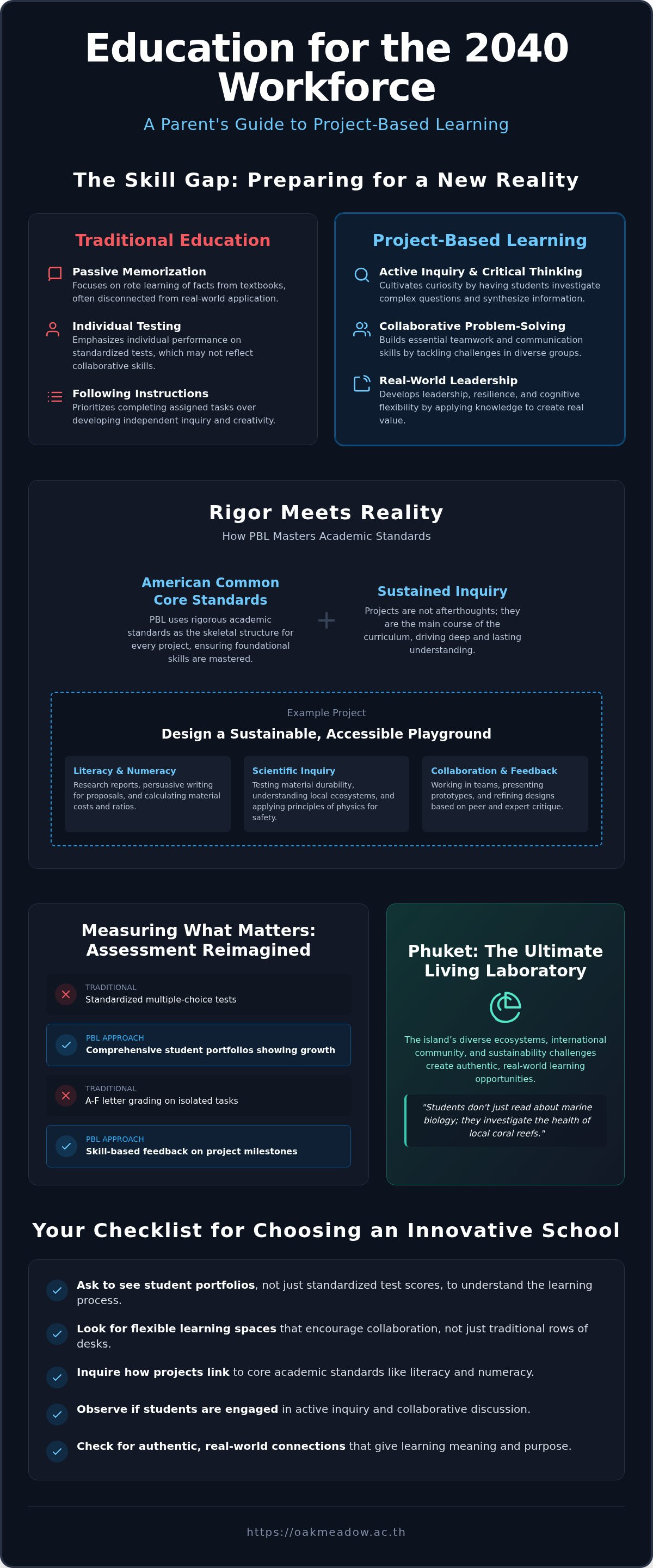
True PBL begins with a hook, which is a challenging problem or question that ignites a child's natural curiosity. For a seven-year-old, this might be: "How can we design a playground that is safe, sustainable, and accessible for everyone?" This initial spark leads to weeks of sustained inquiry. Students research, prototype, and refine their ideas, connecting their classroom work to the authentic, real-world context of life in Phuket. It's about building a bridge between theoretical knowledge, practical application, and community impact.
PBL vs. Traditional Learning: The Skill Gap in 2026
Traditional models often prioritize the rote memorization of facts, yet the 2040 economy will demand the ability to synthesize, analyze, and communicate complex ideas. While individual testing has its place, the future belongs to those who can collaborate across cultures and disciplines. In Phuket's international environment, our students learn to navigate diverse perspectives early on. They develop the emotional intelligence, cognitive flexibility, and leadership capacity required to thrive in a globalized world. It's not just about what they know, but how they use that knowledge to create value together. This approach ensures children aren't just memorizing the past; they're actively building the future.
How PBL Masters Academic Standards: Rigour in the Primary Years
A common concern for parents is whether rigorous academic standards are sacrificed for the sake of creativity. In a high-quality project-based learning primary school phuket setting, the opposite is true. We use the American Common Core standards as the skeletal structure for every project. This ensures that while students are building a solar-powered water filtration system, they're simultaneously mastering complex ratios, persuasive writing, and scientific inquiry. Literacy and numeracy aren't separate subjects; they're the essential tools children use to unlock their projects.
Teachers use "scaffolding," which involves a series of temporary supports designed to ensure every child reaches these milestones. Whether it's through small group mini-lessons or individualized literacy checklists, the framework ensures no student is left behind while research confirms that PBL leads to deeper retention of core concepts compared to traditional instruction. If you're curious about how this looks in practice, exploring American-curriculum excellence can provide a clearer picture of this balanced approach.
| Traditional Assessment | PBL Assessment |
|---|---|
| Standardized multiple-choice tests | Comprehensive student portfolios |
| A-F letter grading on isolated tasks | Competency-based rubrics and growth tracking |
| Private feedback between teacher and student | Public exhibitions, peer review, and self-reflection |
Assessment in the Primary PBL Classroom
In our classrooms, we move beyond the limitations of A-F grades. We utilize competency-based rubrics that measure growth in critical thinking, collaboration, and character. The "Public Product" is a cornerstone of this process. When a child knows they'll present their work to an audience of parents or local experts, their motivation shifts from pleasing a teacher to achieving genuine excellence. This builds a unique brand of confidence that stays with them long after the project ends.
The Role of the Teacher: From Lecturer to Facilitator
The success of this methodology relies heavily on the teacher's ability to transition from a lecturer to a visionary mentor. Authentic facilitators guide inquiry without giving away the answers, fostering a sense of ownership in the student. You can spot "PBL washing" when projects are merely crafts with no underlying research. True inquiry-based teachers are specifically trained to track individual progress within a group setting, ensuring that every child is challenged and supported in their unique academic journey.
Choosing a PBL Primary School in Phuket: A Parent’s Checklist
Selecting the right environment for your child's primary years is a significant decision that requires a balance of intuition and evidence. When you explore options for project-based learning primary school phuket, it's essential to look beyond the brochures. You're looking for a place where curiosity is cultivated, leadership is practiced, and academic standards are lived. Use this structured approach to evaluate whether a school truly embodies the inquiry-based spirit.
- Step 1: Observe the physical environment. Walk through the classrooms and look for flexible spaces. You shouldn't see static rows of desks; instead, look for clusters, collaboration zones, and areas that can be easily reconfigured for group work.
- Step 2: Ask to see student portfolios. Textbooks only show what a teacher intends to cover, but portfolios reveal what a child has actually mastered. Look for evidence of reflection, multiple drafts, and final products that solve real problems.
- Step 3: Inquire about teacher certification. Authentic PBL requires specialized training. Ask if the faculty holds specific certifications in inquiry-based methodologies or has undergone professional development through recognized global organizations.
- Step 4: Look for 'Living Laboratory' signs. A true Phuket school should be deeply connected to its island home. Check for projects that involve local sustainability, community partnerships, or field-based research.
Parents often worry about whether these skills are transferable if the family moves. It's important to remember that the ability to think critically, collaborate effectively, and communicate clearly is the universal currency of modern education. These skills don't just transfer; they're the very traits that help children stand out in any academic setting worldwide. To see these principles in action, you can experience our inquiry-based environment firsthand through a Short Term Trial Programme.
Signs of 'PBL Washing' vs. Authentic Implementation
Be wary of "PBL Washing," where schools treat projects as a "Friday afternoon craft" rather than the core curriculum. In an authentic setting, students have significant "Voice and Choice" regarding their learning paths. They aren't just following a recipe; they're designing the menu. Ensure the school offers a structured academic track from K-12 to provide the long-term continuity your child needs to grow from a curious primary student into a confident global citizen.
The Importance of Campus Facilities
Traditional rows of desks are relics of a bygone era that hinder the collaborative process. A modern campus must feature Maker Spaces and dedicated outdoor learning areas that allow children to build, test, and refine their ideas. Technology should be present but purposeful; it should be used as a tool for creation, research, and presentation rather than just passive consumption. These facilities act as a catalyst for the deep, sustained inquiry that defines a high-quality primary education.
The Oak Meadow Advantage: American Excellence in Phuket
Oak Meadow International School Phuket stands as a purposeful bridge between academic tradition and educational transformation. We integrate rigorous American curriculum standards with a nurturing, inquiry-based approach that respects each child's unique developmental pace. Our campus acts as a primary-level living laboratory where students don't just study geography or environmental science; they engage directly with the island's unique ecosystems and vibrant cultural heritage. By choosing project-based learning primary school phuket at Oak Meadow, you're investing in a foundation that is academically sound, emotionally supportive, and globally relevant.
A Day in the Life of an Oak Meadow Primary Student
The morning begins with "Entry Events," which are provocative questions or hands-on activities designed to spark immediate curiosity and focus. Instead of isolated subjects, students work in integrated blocks where Math and Science concepts are applied to solve a central project challenge. For example, calculating the volume of water needed for a community garden requires both arithmetic precision and environmental understanding. Throughout these collaborative sessions, we place a heavy emphasis on social-emotional learning (SEL). Children learn to navigate disagreements, practice empathy, and lead with kindness, ensuring they grow as resilient thinkers and compassionate human beings.
Our commitment to the whole child extends beyond the core academic day. The extra-curricular activities we offer are intentionally designed to complement our PBL philosophy, giving students additional opportunities to explore their passions in the arts, physical education, and technology. This holistic approach ensures that curiosity isn't confined to a desk but is a vibrant part of every activity on campus.
The Short Term Trial Programme: Experience PBL Firsthand
We believe that transparency builds the strongest partnerships between home and school. This is why we offer our Short Term Trial Programme, allowing families to witness our methodology in action and feel the energy of our classrooms firsthand. During this trial period, we encourage parents to look for signs of engagement, confidence, and joy in their child's daily reflections. It's a risk-free opportunity to see how a "nurturing expert" approach transforms the learning experience from a passive chore into an active adventure. You can Register for a Short Term Trial Programme at Oak Meadow to begin this transformative journey and see the measurable benefits of inquiry-based education today.
Empowering Your Child's Future in an Evolving World
Choosing the right path for your child's primary years is about more than just finding a classroom; it's about selecting a community that values curiosity, innovation, and rigour. We've explored how authentic project-based learning primary school phuket programs move beyond traditional rote learning to cultivate the critical thinking, collaboration, and leadership skills required for the 2040 workforce. By integrating American Curriculum Standards into meaningful, real-world inquiries, children develop a deep academic foundation while discovering their own potential as visionary problem solvers.
At Oak Meadow, we take pride in being Phuket's leading inquiry-based campus, offering a dedicated primary academic track designed to nurture the whole child. We invite you to see this vibrant environment in person and witness the engagement, confidence, and joy in our students' eyes. Book a Campus Tour or Register for our Short Term Trial Programme to experience how we bridge the gap between global standards and individualized growth. Your child's journey toward becoming a confident global citizen begins with a single spark of curiosity. Let's cultivate that potential together.
Frequently Asked Questions
Is project-based learning as rigorous as traditional schooling?
Project-based learning is inherently rigorous because it demands that students apply their knowledge to solve complex, multi-layered problems rather than simply memorizing facts. While traditional methods often focus on passive recall, our approach requires primary students to analyze, evaluate, and create original solutions. This high-level cognitive engagement ensures that children develop a deep, enduring understanding of academic concepts, ultimately preparing them for the sophisticated intellectual demands of higher education and the modern professional world.
How do primary students learn basic math and reading in a PBL environment?
Foundational math and reading skills are treated as essential tools for discovery rather than isolated subjects. In a project-based learning primary school phuket setting, a student might use geometry to design a community structure or apply advanced literacy skills to research environmental policy. These core competencies are reinforced through direct instruction and then immediately applied to meaningful tasks, which creates a purposeful cycle of learning that significantly improves long-term retention, academic confidence, and practical mastery.
Will my child be able to transfer to a traditional middle school after a PBL primary?
Transitioning to a traditional middle school is a seamless process because the core competencies developed through inquiry are universally valued. Students leave our primary program with exceptional communication, collaboration, and self-management skills that allow them to excel in any academic environment. Because our curriculum is anchored in global standards, children remain at or above grade level in core subjects, ensuring they possess the academic readiness and emotional resilience needed to thrive in diverse secondary school settings.
How does Oak Meadow integrate the American curriculum into projects?
Oak Meadow utilizes American curriculum standards as the rigorous framework that guides every project milestone. Our educators carefully map specific learning objectives from the Common Core to project activities, ensuring that each student achieves essential benchmarks in a holistic context. This structured approach allows us to maintain the high standards of an American education while providing the vibrant, inquiry-driven environment that fosters a genuine passion for learning, a spirit of innovation, and a solid academic foundation.
What are the specific benefits of attending an international school in Phuket for PBL?
Attending a Phuket international school offers students a unique living laboratory where global perspectives meet local environmental and cultural challenges. The island's rich biodiversity and diverse community provide endless opportunities for authentic inquiry that simply cannot be replicated in a traditional classroom. Students learn to navigate cross-cultural collaborations and address real-world sustainability issues, gaining a global citizen's mindset that is both deeply respectful of local roots and equipped for international success in an interconnected world.
Are the teachers at Oak Meadow specifically trained in inquiry-based instruction?
Our educators are dedicated professionals who undergo specialized training in inquiry-based methodologies and the project-based learning framework. We prioritize continuous professional development to ensure our teachers remain at the forefront of modern educational theory and practice. This expertise allows them to act as visionary mentors who can guide complex inquiries, manage diverse learning styles, and nurture the individual potential of every child with a sophisticated blend of academic authority and nurturing warmth.
