

By 2026, the traditional middle school model of memorizing textbooks is no longer just outdated; it's a liability for your child's future success. You likely worry that choosing a progressive curriculum might mean sacrificing the academic rigor needed for elite high schools or university readiness. It's a valid concern for any parent who fears that "engaging" learning is just another word for academic fluff without real substance.
This guide proves that project-based learning for middle school phuket is actually the most demanding and effective vehicle for academic excellence available today. You'll discover how a Gold Standard PBL approach equips your child with the critical thinking and real-world problem-solving skills they need to lead in a rapidly changing world. We'll look at how schools like Oak Meadow International School turn the campus into a living laboratory, providing the evidence you need to choose a middle school with total confidence in your child's future. From understanding curriculum rigor to evaluating campus facilities, you'll gain a clear roadmap for navigating the Phuket education market in 2026.
Key Takeaways
- Understand why the 11-14 age window is the most critical time to move beyond rote learning to prevent student disengagement.
- Learn how authentic project-based learning for middle school phuket uses real-world problems and public products to drive academic rigor.
- Identify the specific red flags to look for during campus tours, including physical classroom layouts that stifle collaboration.
- Discover how a purpose-built campus serves as a living laboratory to prepare your child for the global leadership demands of 2026.
Why Middle School is the Critical Window for Project-Based Learning
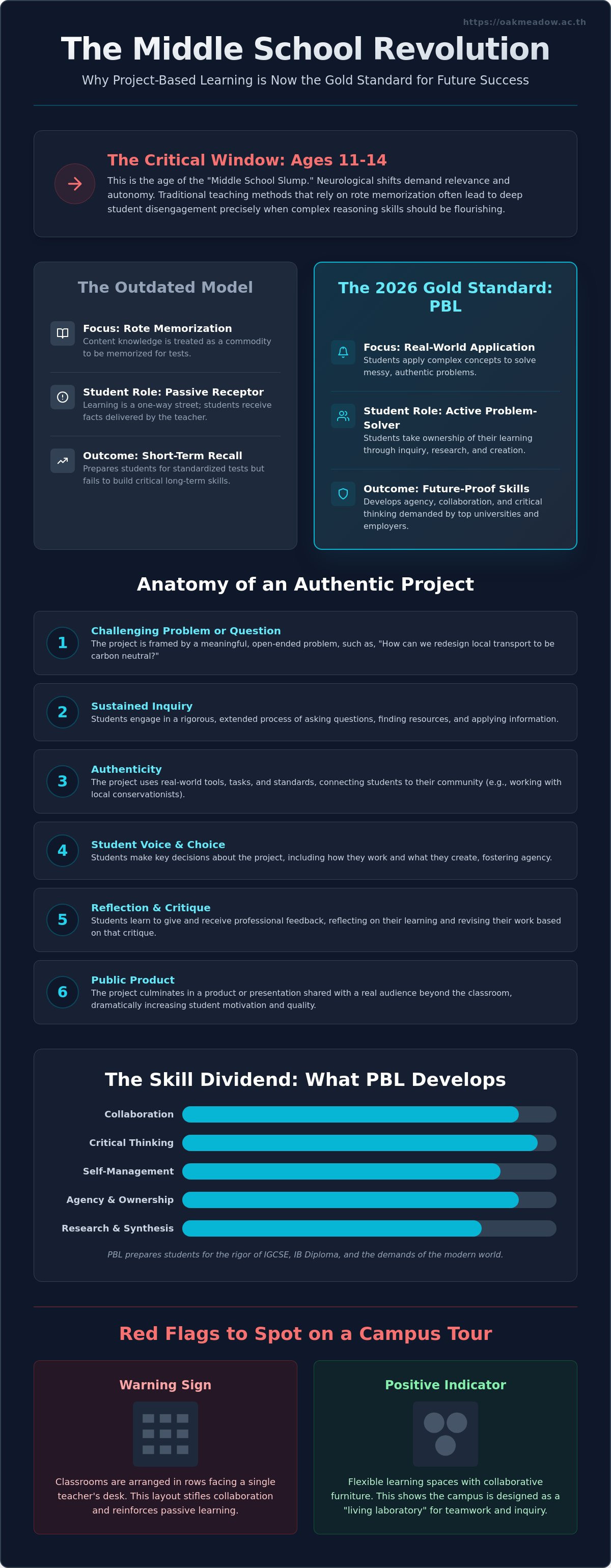
Middle school represents a massive shift in a child's neurological development. Between the ages of 11 and 14, the brain begins to prune unused neural pathways while strengthening those related to complex reasoning and social identity. This is precisely when the "Middle School Slump" often hits. In traditional classrooms, students often feel disengaged because rote memorization fails to satisfy their growing need for autonomy and real-world relevance. They start asking "why does this matter," and traditional schools often lack a compelling answer.
Project-based learning (PBL) flips this script. Unlike a standard curriculum where a project is a "dessert" at the end of a unit, project-based learning for middle school phuket treats the project as the "main course." Students don't just read about biology; they might design a sustainable filtration system for a local Phuket ecosystem. This inquiry-based approach honors their need for agency while anchoring academic concepts in reality. It's the difference between hearing about a problem and being the one tasked to solve it.
The Skill Gap: What Traditional Middle Schools Miss
By 2026, the global economy has made one thing clear: content knowledge is a commodity. With AI capable of retrieving facts in seconds, traditional schools that prioritize memorization leave students unprepared. PBL focuses on "learning how to learn." It builds essential soft skills like self-management, collaboration, and agency. These aren't just buzzwords. They're the foundational skills that 2026 employers demand. Students at Oak Meadow International School practice these daily, using the campus as a living laboratory to solve problems that don't have a single "correct" answer in the back of a textbook.
PBL as a Bridge to High School Rigor
Many parents worry that PBL lacks the "teeth" needed for high-level secondary education. In reality, it builds the exact research and synthesis skills required for IGCSE and the IB Diploma. Transitioning from teacher-led instruction to student-led inquiry is a sophisticated leap. Academic rigor in a PBL environment is defined as the application of complex, abstract concepts to messy, real-world problems. It's much harder to design a functional solution than it is to pass a multiple-choice test. This preparation ensures that when students reach high school, they aren't just surviving; they're leading the conversation.
The Anatomy of an Authentic Middle School Project in Phuket
An authentic project is far more than a colorful poster board or a simple classroom activity. It's a rigorous academic journey built on the core principles of project-based learning. For project-based learning for middle school phuket to be effective, it must incorporate seven essential elements: a challenging problem, sustained inquiry, authenticity, student voice, reflection, critique, and a public product. In this environment, teachers step away from the lectern. They become facilitators who coach students through complex tasks rather than simply delivering facts for them to memorize.
The "Public Product" is the secret to middle school motivation. Young adolescents are socially driven; they care deeply about how their peers and the adult world perceive their work. When students know their findings will be presented to a real audience, the quality of their effort skyrockets. For students who want to elevate the visual impact of their final presentations, you can visit PoscART to explore professional-grade paint markers often used in high-level project exhibitions. This is where critique and revision play a vital role. Students learn to give and receive professional feedback, building the resilience and "thick skin" needed for future leadership. They discover that a first draft is just a starting point, not a final destination.
Phuket as a Living Laboratory
Our island provides a unique backdrop for this type of discovery. We view Phuket as a living laboratory where students tackle local issues with global implications. For example, a marine biology project might involve students working alongside conservationists on Andaman Sea coral restoration techniques. Another group might dive into social entrepreneurship, developing strategies to balance economic growth with sustainable tourism in Old Phuket Town. These aren't just simulations. They're real-world contributions that connect students to their community. Parents looking for this level of engagement often find that Oak Meadow’s purpose-built environment provides the perfect stage for such ambitious work.
The PBL Cycle: From Question to Solution
The PBL journey follows a structured path designed to build independence. It starts with a "Driving Question" that is open-ended and provocative, such as "How can we redesign local transport to be carbon neutral?" This leads to sustained inquiry, where students conduct deep research and gather original data. The cycle concludes with a public exhibition. Whether it's a community proposal or a technical demonstration, presenting to experts transforms the stakes. It turns abstract concepts into lived experiences that students remember long after the project ends.
Evaluating PBL Quality: A Framework for Phuket Families
As you explore options for project-based learning for middle school phuket, you'll find that many schools use the term in their brochures. However, there's a significant difference between "doing projects" and a dedicated PBL curriculum. Authentic implementation requires a total shift in school culture, scheduling, and physical environment. Identifying "PBL-washing" is essential for parents who want to ensure their child isn't just completing arts and crafts under a different name.
Start by looking at the classrooms. If you see rows of desks facing a whiteboard, it's a sign that the teacher remains the sole source of information. PBL thrives in flexible spaces where students can group and regroup as their research evolves. You should also ask about teacher qualifications. In 2026, look for educators specifically trained in inquiry-based instruction or those holding Gold Standard PBL certifications. These teachers act as coaches, guiding students through the struggle of discovery rather than just delivering lectures.
Grading often worries parents used to traditional systems. In a true PBL setting, assessment is continuous and transparent. Teachers use detailed rubrics to track growth in collaboration, critical thinking, and self-management alongside subject mastery. Authentic PBL uses assessment as a tool for growth, not just a final ranking. To see what a Gold Standard environment looks like in practice, you can book a personal tour of the Oak Meadow campus and observe student-led inquiry firsthand.
The School Tour Checklist
- Student Agency: Ask "Who chooses the project topics?" If the answer is always the teacher, student agency is missing.
- Diversity of Work: Look at displayed projects. If every student's final product looks exactly the same, it was a recipe-based activity, not an inquiry-based project.
- The Public Product: Ask "Who was the last external audience for a project?" Authentic PBL requires students to present to someone other than their teacher.
Comparing Curriculum: PBL vs. Traditional International Schools
| Feature | Traditional Learning | Authentic PBL |
|---|---|---|
| Student Role | Passive recipient of facts | Active investigator of problems |
| Assessment | Heavy focus on final exams | Continuous feedback and portfolios |
| Classroom | Static rows of desks | Flexible, collaborative hubs |
| Outcome | Standardized test scores | Real-world skills and products |
While traditional schools focus on coverage of content, PBL schools prioritize the application of that content. This ensures students don't just "know" the material for a test but can actually use it to solve complex challenges in the real world.
Why Oak Meadow is Leading Middle School PBL Innovation in 2026
Oak Meadow International School doesn't just teach a curriculum; it builds the environment where that curriculum comes to life. Our "Future-Ready" philosophy recognizes that middle schoolers in 2026 need more than a desk and a textbook. They need a hub for innovation. Our purpose-built campus was designed specifically for project-based learning for middle school phuket, providing the collaborative spaces where student-led inquiry can flourish. This isn't a traditional school building. It's a living laboratory where students integrate advanced technology with the rich, local culture of Phuket to solve actual community challenges.
The strength of our program lies in our community. With approximately 300 students representing 20 different nationalities, Oak Meadow provides a diverse, global perspective that is essential for collaborative problem-solving. This multicultural environment ensures that when students tackle a project, they aren't just looking at it through a single lens. They're learning to lead in a world that demands cultural intelligence and empathy.
A Day in the Life of an Oak Meadow Middle Schooler
A typical day balances rigorous core academic instruction with dedicated project time. For example, as international curriculum standards for subjects like History see updates in 2026, our students use those new frameworks to analyze modern social trends right here in Thailand. This mentorship model ensures that expert educators, trained in inquiry-based instruction, guide every step of the process. Parents can explore this methodology in detail through the Oak Meadow E-Book, which outlines how we bridge the gap between academic theory and real-world practice.
Preparing Global Leaders in the Heart of Phuket
Our students solve real-world problems today so they can lead the global economy tomorrow. Whether they're developing environmental solutions for local beaches or creating digital platforms for Phuket businesses, they're gaining the agency that traditional schools often overlook. We're currently welcoming families for the 2026/2027 intake, helping you navigate the latest Thai Ministry of Education regulations regarding international student enrollment. We invite you to Register Interest and schedule a personalized campus tour. Seeing project-based learning for middle school phuket in action is the only way to truly understand how it will redefine your child's future.
Empower Your Child for the 2026 Global Economy
Choosing the right educational path for the middle school years is one of the most impactful decisions you'll make for your child's future. You now understand that authentic project-based learning for middle school phuket is much more than a teaching method. It's a rigorous framework that builds the research, collaboration, and critical thinking skills required for high school success and beyond. By prioritizing inquiry over rote memorization, your child learns to navigate the complexities of a rapidly changing world with genuine confidence.
Oak Meadow International School provides the ideal environment for this transformation. With our Gold Standard PBL Curriculum, purpose-built collaborative learning spaces, and expert faculty trained in inquiry-based learning, we ensure every student is prepared to lead. We turn the traditional classroom into a living laboratory where academic concepts meet real-world solutions.
Take the next step in securing your child's academic and professional success. Download the 2026 Oak Meadow Middle School Prospectus today to see how we prepare the global leaders of tomorrow. We look forward to helping your family discover the power of student-led discovery.
Frequently Asked Questions
Is project-based learning as rigorous as traditional middle school curricula?
Yes, PBL is often more rigorous because it requires students to apply high-level concepts to solve unpredictable problems. While traditional curricula focus on memorizing facts for a test, students in a PBL environment must master the same content to create a functional product or solution. This deep level of understanding ensures they don't just know the material but can actually use it in professional contexts.
How do middle schoolers in PBL schools prepare for high school exams like IGCSE?
PBL builds the exact research, synthesis, and time-management skills required for success in IGCSE and IB Diploma programs. By the time students reach these high-stakes exams, they've already spent years conducting independent investigations and defending their work to external audiences. This academic stamina makes the transition to standardized testing smoother, as they're already comfortable with complex, multi-step tasks and critical analysis.
What are the benefits of project-based learning for expat students in Phuket?
For expat families, project-based learning for middle school phuket offers a unique way to connect with the local community while building global leadership skills. Students work on projects that directly impact the island, from local environmental sustainability to economic development initiatives. This hands-on approach helps students feel a sense of belonging and purpose in their host country while developing a resume of real-world achievements.
How does project-based learning handle students who struggle with collaboration?
Collaboration is a taught skill in the PBL framework, not just a requirement. Teachers use tools like group contracts, specific role assignments, and structured peer feedback sessions to help students navigate interpersonal challenges. If a student struggles with teamwork, they receive targeted coaching to develop their communication and conflict-resolution abilities. This ensures every student learns how to contribute effectively to a professional team environment.
What should I look for in a PBL teacher’s qualifications?
You should look for educators who hold specialized certifications in inquiry-based instruction or have been trained by recognized PBL organizations. In 2026, the best teachers act more like professional coaches than traditional lecturers. They should have a proven track record of facilitating student-led projects and the ability to design rubrics that measure both subject mastery and essential soft skills like critical thinking.
Can students with different learning styles succeed in a PBL environment?
Different learning styles are naturally accommodated because project-based learning for middle school phuket involves diverse tasks. A single project might require visual design, technical writing, public speaking, and data analysis. This allows students to lead with their strengths while receiving support in areas where they need growth. The variety of roles within a project ensures that every student finds a way to contribute and succeed.

