

What if your child’s most impactful classroom was twenty meters beneath the surface of the Andaman Sea? Choosing the right after school activities phuket often feels like a high-stakes balancing act between safety, cost, and genuine educational value. You might feel overwhelmed by the choice between PADI and SSI certifications or worry about how a deep-sea hobby fits into a busy 2026 school schedule. It's natural to have questions about underwater safety protocols or whether the investment will truly benefit your child's future.
This guide will show you how scuba diving serves as a premier developmental tool that turns the ocean into a living laboratory for science, discipline, and personal growth. You'll learn about the certification process for students aged ten and up, explore the safety of Phuket’s healthy reefs, and see how diving experience can actually strengthen a student’s university portfolio. We will break down the latest 2026 regulations, such as the mandatory four-to-one diver-to-guide ratio, so you can feel confident as your child explores the world-class dive sites right on our doorstep.
Key Takeaways
- Learn how modern scuba equipment acts as a safe underwater life-support system, transforming complex physics into a practical and engaging hobby.
- Discover why diving is one of the most rewarding after school activities phuket offers, blending marine biology with character-building responsibility.
- Follow a clear, three-step roadmap to certification that balances flexible e-learning with hands-on safety drills in a controlled pool environment.
- Explore why Phuket’s world-class sites, such as Racha Yai and Koh Phi Phi, serve as ideal "living classrooms" for beginner divers in 2026.
- Understand how early scuba certification can enhance university applications by demonstrating a commitment to environmental stewardship and personal growth.
What is Scuba? The Fundamentals of Underwater Exploration as a Hobby
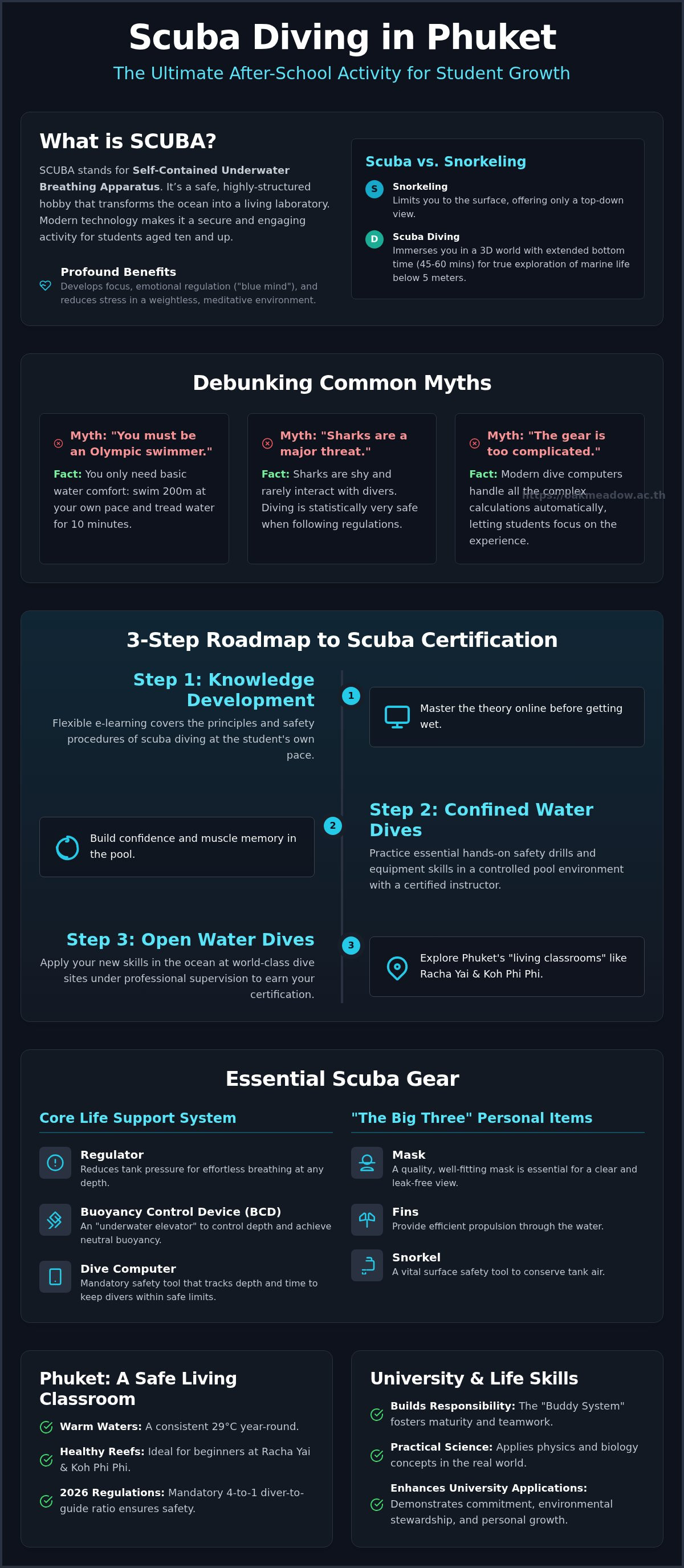
Scuba stands for Self-Contained Underwater Breathing Apparatus. It is a sophisticated system that allows you to carry your own air supply, effectively turning the ocean into a temporary home. While diving began as a tool for military frogmen and salvage experts, it has evolved into a highly structured and safe hobby for students. When you understand scuba diving fundamentals, you realize it is less about adrenaline and more about disciplined exploration. In 2026, technology like integrated air transmitters and high-resolution dive computers makes this one of the most secure after school activities phuket offers. These tools monitor depth and air levels automatically, providing a safety net that lets students focus on the marine world.
Beyond the technical gear, diving offers profound psychological benefits. The weightless environment provides a sense of freedom that is impossible to find on land. For students balancing heavy schoolwork, the quiet of the underwater world reduces stress and builds intense focus. It's a form of active meditation where the only sound is your own rhythmic breathing. This "blue mind" state helps young learners develop emotional regulation and a calm mindset that carries over into the classroom.
Scuba vs. Snorkeling: Why Go Beyond the Surface?
Snorkeling limits you to the surface, but scuba invites you into a full 3D world. You gain extended bottom time, often staying down for 45 to 60 minutes to watch a sea turtle feed or a clownfish guard its anemone. This depth is essential for serious marine science study, as many unique species and behaviors only occur below five meters. Students develop superior spatial awareness by learning to move in all directions, mastering buoyancy control to hover perfectly still in the water column.
Debunking Common Beginner Myths
Many parents hesitate because of common misconceptions. First, you don't need to be an Olympic swimmer. As long as you can swim 200 meters at your own pace and tread water for ten minutes, you're ready to start. Second, sharks are not a threat to divers. They are shy creatures that rarely interact with humans, and real-world safety statistics prove that diving is incredibly safe when following 2026 regulations. Finally, modern gear isn't overly complex. Digital computers now handle the "math" of dive tables, letting students enjoy the experience while the technology ensures they stay within safe limits. This makes it one of the most accessible after school activities phuket provides for students aged ten and up.
Essential Scuba Gear: Understanding Your Underwater Life Support
Scuba gear acts as a student's personal life-support system, turning the deep sea into an accessible environment. The regulator is the most critical component; it reduces high-pressure air from the tank to the exact ambient pressure of the surrounding water. This allows for natural, effortless breathing at any depth. To move through the water with grace, divers use a Buoyancy Control Device (BCD). Think of it as an underwater elevator that helps you stay perfectly still or change depth without heavy kicking. Since Phuket’s tropical waters remain a warm 29°C throughout 2026, students typically use light 3mm exposure suits or simple rash guards for protection. Modern safety is further enhanced by the dive computer, a mandatory tool that tracks every second of a dive to keep students within safe physiological limits.
Learning to manage this equipment is a core part of the scuba certification roadmap. It provides a practical application for school subjects like physics and biology, making it one of the most rewarding after school activities phuket provides for students aged ten and up.
The 'Big Three' Personal Items for Students
While most gear is provided by dive centers, students often prefer owning their "Big Three" items for a better fit. A high-quality mask with a soft silicone skirt and tempered glass is essential to prevent leaks and ensure a clear view of the reef. Choosing the right fins is also vital. Full-foot styles are great for boat dives, while open-heel fins paired with boots are better for Phuket’s beach entries where sand and rocks are common. Finally, a snorkel remains a vital piece of surface safety gear, allowing students to conserve tank air while swimming to and from the dive site.
How Gear Builds Responsibility
Handling scuba equipment fosters a level of maturity rarely seen in other hobbies. Students must master the "Buddy System," which involves performing a five-step safety check on their partner’s gear before every single entry. They also learn the importance of gear maintenance, such as rinsing delicate valves in fresh water to prevent salt crystals from forming in Phuket’s humid climate. The BCD and lead weights work together to balance upward and downward forces, allowing the diver to achieve a state of perfect weightlessness. This hands-on responsibility aligns perfectly with the holistic development goals at Oak Meadow, where students are encouraged to take ownership of their safety and environment. It is this combination of technical skill and personal accountability that makes diving stand out among other after school activities phuket offers.
The 3-Step Roadmap to Scuba Certification in Phuket
Earning a scuba certification is a structured journey that fits easily into a student's weekly schedule. It begins with Knowledge Development through interactive e-learning. This digital phase allows students to study the physics of diving and coral reef conservation at their own pace, making it one of the most flexible after school activities phuket offers. Once the theory is complete, students move to Confined Water Skills. In a controlled pool environment, they practice essential safety drills like regulator recovery and mask clearing until these actions become second nature. The final step involves four Open Water Checkouts, where students apply their skills in the Andaman Sea over two days. Both PADI and SSI are the recognized gold standards in Thailand. They offer nearly identical safety standards and global recognition, ensuring your child’s license is valid at any dive center in the world.
Junior Open Water: Diving for Younger Students
Junior certifications are specifically designed for younger explorers. Students aged 10 to 14 earn the Junior Open Water title, which transitions to a full Adult certification automatically at age 15. For those under 12, depth is strictly limited to 12 meters to ensure maximum safety. Beyond the fun, this credential is a powerful addition to a student’s CV. It proves they can handle high-level responsibility and master complex STEM concepts in a real-world setting. At Oak Meadow, we see how this path builds the confidence necessary for academic success. To see how these skills translate into the classroom, explore the holistic programs at Oak Meadow.
What to Expect on Your First Ocean Dive
The first time a student breathes underwater in the ocean is a transformative sensory experience. The typical noise of life disappears, replaced by the rhythmic sound of bubbles and the vibrant colors of the reef. Instructors maintain a strict 1:4 student-to-teacher ratio in 2026, ensuring every child receives personalized attention during their first descent. They'll master basic skills like clearing a partially flooded mask while surrounded by tropical fish, proving they can remain calm and focused in a new environment. This hands-on mastery is a core reason why diving is becoming one of the most popular after school activities phuket provides for international students.
Phuket as a Living Classroom: Scuba and Marine Conservation
Phuket isn't just a tourist destination; it's a premier global hub for marine education. The island's proximity to the Andaman Sea allows students to swap traditional classrooms for the calm, turquoise bays of Racha Yai. These sites provide a safe, predictable environment for beginners to master their skills before exploring the incredible biodiversity of Koh Phi Phi. Students don't just see marine life; they learn to identify the five species of sea turtles that nest in the region and observe the complex symbiotic relationships within a reef. This hands-on approach makes diving one of the most effective after school activities phuket offers, as it bridges the gap between abstract textbooks and the physical world.
The transition from theory to practice is where diving truly shines as a STEM-based hobby. Students see Boyle’s Law in action every time they equalize their ears or watch their bubbles expand during an ascent. They study the biology of coral reefs, witnessing how these "rainforests of the sea" provide a home for thousands of species. By applying physics and biology in a real-world setting, young learners develop a deeper understanding of academic disciplines that can often feel disconnected from daily life in a standard school setting.
This educational journey doesn't have to stop at the water's surface. Developing a broader set of maritime skills, such as those taught at Vaarschool.be, can further enhance a student's technical knowledge and sense of responsibility on the water.
Environmental Stewardship in the Andaman Sea
Phuket's 2026 regulations are stricter than ever to protect our local heritage, and students are at the forefront of these conservation efforts. Divers are taught the vital "look but don't touch" rule, and current laws mandate a minimum two-meter distance from all coral reefs to prevent accidental damage. Beyond basic rules, diving opens doors to meaningful citizen science. Students can participate in local turtle monitoring programs or reef clean-ups, gaining a firsthand look at how climate change and human activity impact Phuket's ecosystems. This fosters a deep sense of environmental stewardship that is central to a modern international education.
Scuba as a Holistic After-School Activity
Underwater, students develop essential life skills that translate directly back to the classroom. Since verbal communication is impossible, they must master non-verbal signals and intense teamwork with their dive buddy. There is also a high level of discipline required to "plan the dive and dive the plan," a mantra that teaches students the importance of preparation and following safety protocols. This structured environment builds the confidence and responsibility needed for future leadership roles. Discover how Oak Meadow International School fosters student growth through diverse after-school opportunities that prioritize both academic excellence and personal development. It is this combination of science, safety, and character building that makes diving a standout choice among after school activities phuket families can choose today.
Dive Into Your Child's Future Today
Choosing the right hobby means finding a balance between adventure and academic value. Scuba diving transforms the Andaman Sea into a dynamic classroom where students master the physics of pressure and the biology of coral reefs. By following the structured certification roadmap, young divers build lifelong habits of responsibility and environmental stewardship. It's one of the most impactful after school activities phuket offers, providing a distinct advantage for university applications and long-term personal growth.
Oak Meadow is located in the heart of this world-class diving region. We are committed to student safety and developing essential life skills that extend far beyond the traditional classroom. Our focus on holistic development ensures that students become active protectors of the marine world they explore. Explore Holistic After-School Activities at Oak Meadow International School and see how we help students reach their full potential. Your child's next great discovery is waiting just below the surface.
Frequently Asked Questions
How old does a student need to be to start scuba diving in Phuket?
Students must be at least 10 years old to enroll in a Junior Open Water Diver course. This age requirement ensures that children have the physical maturity and cognitive ability to master essential safety drills and theory. While younger children can sometimes participate in shallow pool experiences, the path to a globally recognized certification begins at age ten. It's one of the most rewarding after school activities phuket offers for upper elementary and middle school students.
Is scuba diving an expensive after-school activity for beginners?
Diving requires an initial investment in training and certification, but it's comparable to other high-skill sports like competitive swimming, tennis, or the martial arts programs at Bushi Ban Child Care. The primary cost is the certification course, which includes all digital learning materials and professional instruction. Once a student is certified, they hold a lifelong license, meaning they don't have to pay for basic training again. Many families find that the long-term educational benefits and university application boost outweigh the entry costs.
Does my child need to be a strong swimmer to get certified?
Your child doesn't need to be an Olympic-level athlete, but they must be comfortable in the water. To meet the 2026 certification standards, students must be able to swim 200 meters unaided and tread water or float for 10 minutes. There's no time limit for the swim, and students can use any stroke they prefer. These requirements ensure that every diver can safely manage themselves at the surface before and after their underwater adventure.
Can you dive if you wear glasses or contact lenses?
Diving with vision correction is very common and completely safe. Most divers prefer wearing soft contact lenses under their mask, as the water pressure doesn't affect them. If your child doesn't wear contacts, you can easily find prescription masks with corrective lenses. This ensures they can clearly see the vibrant coral reefs and read their dive computers without any difficulty. Clear vision is essential for enjoying the full experience of after school activities phuket underwater.
How long does a PADI or SSI scuba certification last?
A scuba certification from PADI or SSI lasts for a lifetime and never expires. Once your child completes their four open water check-out dives, they are certified to dive anywhere in the world. If they go a long period without diving, usually six months or more, it's standard practice to take a short refresher course. This quick session helps them review safety protocols and regain confidence in their equipment handling before heading back into the ocean.
What is the best time of year for students to dive in Phuket?
The peak diving season in Phuket runs from November to May when the Andaman Sea is at its calmest. During these months, underwater visibility is excellent, often exceeding 20 meters at sites like Racha Yai. This period also coincides with the opening of the Similan Islands marine park in mid-October. While students can dive year-round in sheltered bays, the dry season offers the most consistent conditions for beginners to practice their skills and observe diverse marine life.

